Since we are focusing on moms this month, I thought I would share some great parenting tips from a Mom who recently taught me a lot. But before I do, I just have to put in a plug for Family Life's Weekend to Remember Marriage Getaways. Mark and I just attended one last weekend, and it was amazing for us. We didn't have any major problems in our marriage, but just knew we were exhausted and needed to get away and focus on each other and connect. I was looking for something fun for us to do in Charlotte (I have to now admit that we chose Charlotte simply because it had the closest IKEA and I'd been wanting to go there for years :) and found the marriage get-a-way and thought it would be a great way to get us to focus on each other. I mentioned it to Mark and he laughed in my face. Sitting through a conference was definitely not what he wanted to do on our get-a-way! So I dropped it. I told him he could plan whatever he wanted for us. And two weeks later he brought it up again and said we could do the marriage conference as long as we didn't have to go to every single session. Ha! We almost dropped the idea again because of the price, but Family Life people are super nice and will give scholarships based simply on "what you and your husband have decided you can afford."
Mark and I looked at the schedule and decided which sessions we would attend... some of the sessions sounded very redundant to information we had learned in Seminary so we decided to skip many of them. We actually only made it to 4 out of 10 sessions but those 4 sessions were indeed invaluable to us. I'm talking, life-changing, "I feel like we are courting again" type of impact! (In retrospect, we probably would have learned much in the other sessions as well, but the 4 we attended gave us more than enough to process and work on.) I expected to get a lot from the conference (being the relationship-oriented, emotional woman that I am), but I was amazed at how much it changed my husband as well. He didn't even want to go to the conference originally, but has said many times since how glad he was that he went and how he wishes others that we know could go to one as well.
Sorry this has gotten to be such a long plug, but I felt like I really needed to share because it helped us so much. Since this is a blog specifically for exhausted moms of little ones, I am certain that we are not the only ones who unknowingly settled into "companionship" mode without even realizing it. We love our kids and the life that we enjoy with them and we truly get along great so we did not even realize that our marriage had become complacent. Weekend To Remember is a wonderful tool to get the communication flowing in all areas of marriage and God greatly used it to recharge ours!
The wife and mother who spoke at the conference did one session on parenting and she told her top ten tips for kids. I knew many of them already, but the session was a good reminder and listening to her tips helped me to think about what areas of parenting I need to work on. It also helped me think more about the future of my kids and our goal in parenting. (I tend to get so caught up in the here and now of the little years that I often forget that we are doing such training so they can be independent but wise and godly teenagers.) I hope these tips will be helpful to you as well:
1. Set limits -- kids need limits and they find security in them.
2. "We play to an audience on one." This one was a particularly good reminder for me because I parent very differently than a lot of people I know and I need to stop worrying about what others are thinking about my parenting style. What matters is that I am in prayer and doing what God has called me to do. I raise my children for Him, not anyone else.
3. My job is not to be my child's best friend! She went on to say that friendship does come later and right now she is enjoying a sweet, sweet friendship with her teenage and college-age kids. But the little years are for training and instructing in righteousness and much discipline.
4. Because of all the boundaries and discipline that come with #3, try to say yes to as many things as you can so that when you do say no, it really means something.
5. Give them the Biblical reasons behind the rules and limitations -- we do not just want good behavior, but to help them make good decisions in the future!
6. When you take something away, give them something better -- she gave the example of beach week in the South, where kids always go to the beach and party like crazy for a week after school lets out. They never let their kids attend beach week, but instead used that week to plan amazing family vacations.
7. Stay calm and loving in discipline -- you don't want them to think you are disciplining simply because you are mad, but because you love them and are obeying God in training them in righteous living.
8. The less you react in the moment, the more your kids will come to you with their moments. If a child comes home and tells you something incredibly shocking that happened in school, if you get all upset and immediately call the principal, the child will probably not choose to confide in you the next time something disturbing happens.
9. Focus on unconditional love -- when you discipline, tell them that you are disappointed, that they sinned, but that it does not change your love for them.
10. Pray that they would get caught! You will not be with them every moment and will not catch every sin, so pray that they will get caught before their sin grows so they can deal with it and learn from it. (Sidenote: my own mother did this and told us that she did and God definitely answered her prayer -- my brother and I never got away with anything! :)

Showing posts with label Training your Children. Show all posts
Showing posts with label Training your Children. Show all posts
Great parenting tips and a plug for a marriage get-away
Posted by | Thursday, May 3, 2012 at 9:47 AM
Raising a Reader
Posted by | Wednesday, January 11, 2012 at 2:05 PM
I have been reading Lit! A Christian Guide to Reading Books by Tony Reinke, and it has been very helpful in guiding me through a structure for reading. One of his last chapters is called "Raising Readers," and gives suggestions to parents for how to encourage your children in reading. I enjoyed the chapter greatly, and wanted to pass along his suggestions to our readers (Note: the main points are his, the additional "thoughts" are mine). I'd love to hear your thoughts!
1. Fill your home with books--seems obvious, but kids will learn to love books if they are around books.
2. Read to your kids :-)
3. Don't stop reading to your kids--read to them even when they are older! See The Read-Aloud Handbook for suggestions on reading aloud to your kids.
4. Read your books in front of your kids--model a habit of book reading in front of your children. Reinke even encourages you to try to read "heavy" books in front of your kids, not just "lite fluffy reading". Again, it is about modelling a love of reading to your kids.
5. Teach young children to read
6. Push entertainment to the background
7. Listen to audio books in the car--check out free classic audiobooks here
8. Hunt for the best books--ask for people to recommend books to you. Consult a literature guide like Honey for a Child's Heart or Books Children Love, and read book reviews on the blog Orange Marmalade.
9. Anticipate new books--attend book signing events, anticipate the day a new book is released, etc.
10. Celebrate the classics--find something fun to reenact or celebrate in a book. Reinke and his family celebrated Hobbit Day in the fall :-)
11. Cultivate your child's moral imagination
12. Help interpret worldviews as you read to your children--walk through tough situations with them, explaining why characters made certain choices, and help them discern the worldview presented
13. Read your favorite excerpts to your children
14. Invite your children to read to the family
15. Challenge your children to improve books--ask them what they would change about the book, or how they would improve it.
16. Most importantly, read the Bible together as a family
What suggestions do you have for cultivating a love of reading in your children? How are you cultivating a love of reading yourself?
1. Fill your home with books--seems obvious, but kids will learn to love books if they are around books.
2. Read to your kids :-)
3. Don't stop reading to your kids--read to them even when they are older! See The Read-Aloud Handbook for suggestions on reading aloud to your kids.
4. Read your books in front of your kids--model a habit of book reading in front of your children. Reinke even encourages you to try to read "heavy" books in front of your kids, not just "lite fluffy reading". Again, it is about modelling a love of reading to your kids.
5. Teach young children to read
6. Push entertainment to the background
7. Listen to audio books in the car--check out free classic audiobooks here
8. Hunt for the best books--ask for people to recommend books to you. Consult a literature guide like Honey for a Child's Heart or Books Children Love, and read book reviews on the blog Orange Marmalade.
9. Anticipate new books--attend book signing events, anticipate the day a new book is released, etc.
10. Celebrate the classics--find something fun to reenact or celebrate in a book. Reinke and his family celebrated Hobbit Day in the fall :-)
11. Cultivate your child's moral imagination
12. Help interpret worldviews as you read to your children--walk through tough situations with them, explaining why characters made certain choices, and help them discern the worldview presented
13. Read your favorite excerpts to your children
14. Invite your children to read to the family
15. Challenge your children to improve books--ask them what they would change about the book, or how they would improve it.
16. Most importantly, read the Bible together as a family
What suggestions do you have for cultivating a love of reading in your children? How are you cultivating a love of reading yourself?
Demanding and arguing
Posted by | Thursday, October 27, 2011 at 2:25 PM

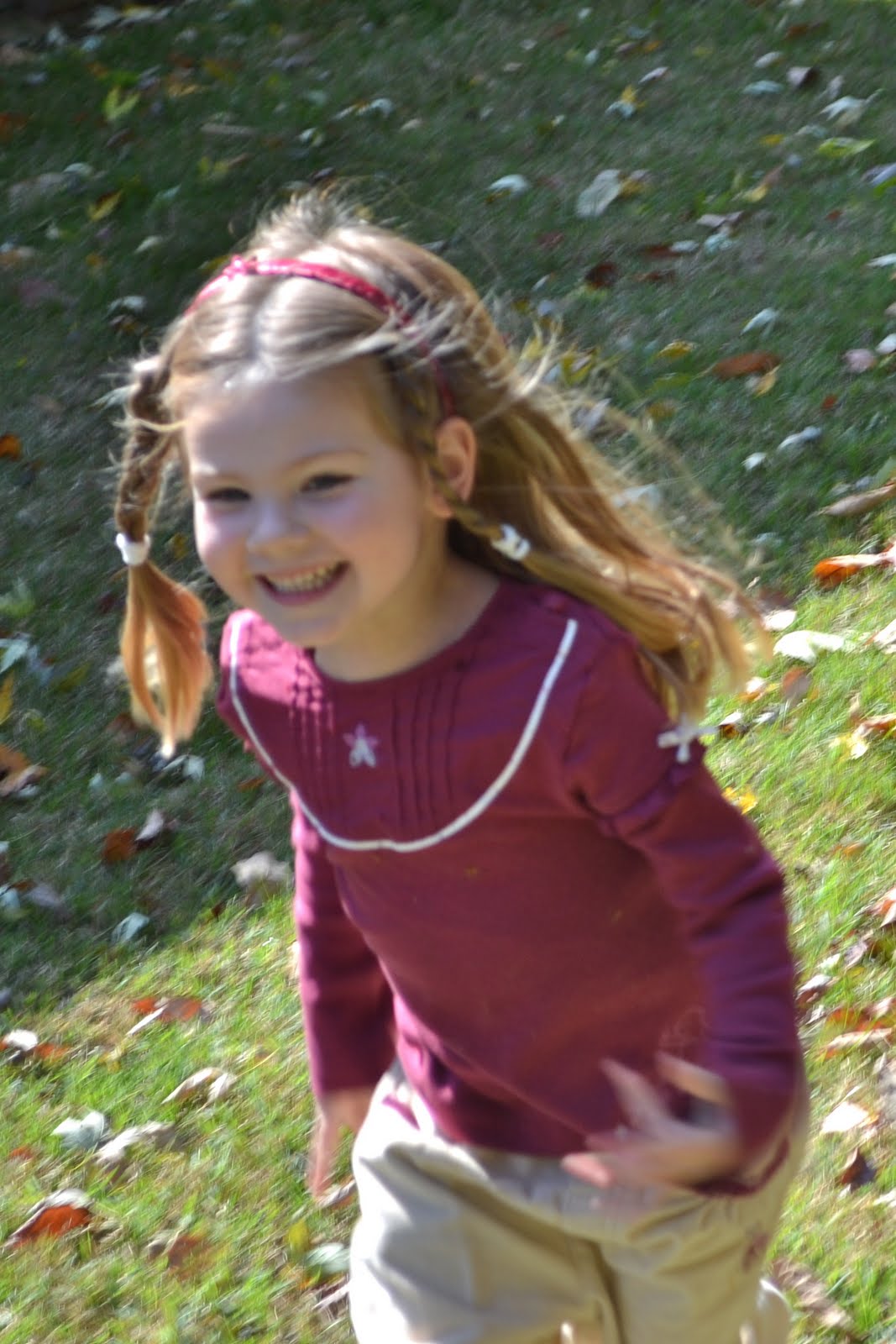
My 4.5 year old is an absolute joy! She is the best helper I could ever wish for, she takes great delight in taking care of her little sisters, and her unbelievable imagination just fills my life with laughter. But she seems to have forgotten her manners a little and we are working hard to get her back to where we were just a few short months ago. We have two major issues that we are working on right now and I thought I'd share them and what we are doing to correct them. I'm just going to be honest and I'd love to hear your tips as well!
1. She has forgotten "please." Even before she could talk, Karis signed the word "please" when she wanted something. But lately, she has forgotten it and can be quite demanding. I think she got into the habit because she enjoys telling her little sister what to do so much, but it has transposed into telling adults what to do as well. So we are trying to quickly nip it in the bud. It is amazing how quickly a habit forms when you aren't paying attention and then it is difficult to erase!
Basically, we are refusing to acquiesce when she asks for something in a demanding way. She has to wait 3 minutes and then she may ask again correctly and we will fulfill her request. For example, if she says, "Give me more milk," then I respond, "no, you did not ask respectfully and you can try again in 3 minutes." In the car, she has a habit of wailing from the back of the van, "I can't hear the music!" So we completely turn off the music for 3 minutes and then give her the chance to ask us to turn it up respectfully. It has taken a while for her to remember, but we are definitely seeing progress. She will often start to demand something and quickly cover it up with a "will you please?"
2. She has developed good reasoning ability that has grown to arguing (otherwise known as "too smart for her own good "). Our family has always tried to implement first time obedience with a bit of grace thrown in. (And no, I have not yet read "Give Them Grace," but I would really like to. If you have read it, please comment and share your thoughts!) For instance, if Karis is reading a book and I ask her to go take her clothes to her room, she is allowed to say, "May I please finish this book first?" If she asks respectfully, we are not in a hurry to do something else, and there are not many pages left, I usually allow her to finish. But if I say no, she must immediately get up and do it. This method has worked well for the first 4 years of her life, but now she is taking it a bit to far. I ask her to do something and she says, "Well....." or, "but Mama...!" She usually has great logic that makes me laugh but the core problem is that she is making excuses instead of obeying right away. A lot of times, the things she says she needs to do first are really good things, such as helping Karlie or Abbi with something, but it is still disobedience. And often when I tell her no, that she must obey first, she begins to argue to try to explain why she is right. I don't have any great plan for this issue, other than immediate discipline and to try to always take the time to talk to her and explain why this is biblically a problem and try to reach her heart and pray with her. But boy is it difficult to find the time to do all that when my other two little ones are running around needing me!
Those are the two major parenting issues we are dealing with this week. What about you? I'd love to hear your struggles or advice!

Triumphs and Struggles
Posted by | Wednesday, October 5, 2011 at 6:15 PM
Parenting has an ebb and flow--there are frequent ups and downs, and when you feel like you have something under control, something new and unexpected 'pops' up.
Bad habits seem to be conquered and then they reappear--good habits and tendencies look established, but then one bad day throws it all. It should continually remind us that everyone has sinned and fallen short of God's glory (Rom. 3:23), but that Christ became sin for us so that we might be made righteous in His sight (2 Cor. 5:21). We must turn to Christ and rely on him for our salvation, and for the strength to parent our children!
In an effort to 'keep it real', I thought I would share some triumphs and struggles I am having with each of my children. Perhaps something my family is going through will be an encouragement to you, and we will all realize that there is nothing new under the sun!
Eleanor, age 9 months
 Triumphs: Eleanor is the sweetest, easy-going baby a mom could want. She loves her big siblings, and is good natured enough to go to just about anyone who wants to hold her. After 'army crawling' for a couple of weeks and rolling around like crazy before then, she crawled a few paces last night. The world is changing for her, and that is very exciting!
Struggles: E has been battling a cold, and as such her sleep during the day and overnight have been erratic. She is still very sweet for the most part. The only other major struggle we have is that 'people food' sometimes makes her constipated. Having a little baby who struggles to poop is sad :-(
Baxter, age 3 years
 Triumphs: After taking a long time to form words, Baxter's vocabulary is exploding and he can hold conversations and tell stories with the best of them. His imagination is growing, as is his appetite! Overnight it seems that he just can't get enough to eat. I am glad to see it, though, because he was a fairly picky eater who didn't consume much...and now I can't keep him satisfied! He takes in much more than I realized, as I recently quizzed him on the catechism we use with Georgia and he knew most of the answers! B is very affectionate, and loves snuggle times with Mommy and Daddy, and of course we don't mind that.
Struggles: Though he talks A LOT, he has a slight lisp which can make some words hard to understand (especially for someone who is not mom). He struggles with controlling his temper, and is entering a "being belligerent and testing parents" phase. Also, we have dealt with this several times in his life, but he has a hard time going back to sleep if he wakes up in the middle of the night. And he wakes up screaming or saying "OW!" or both. We have to put Georgia in a separate room to sleep while we help sort Baxter out. We are right in the middle of this right now, and it's exhausting. He is doing the same thing at naptime and the only time he complains about something hurting is when he wakes up from sleep OR is about to be disciplined. Pray for us to figure out what to do.
Georgia, age ALMOST 5 years (birthday Oct 21)

Triumphs: Georgia is finding great delight in being a helper to Mommy, and loving on her younger brother and sister. She plays so well with B and E both! She never minds if E pokes her face or pulls her hair (as long as it is not too hard). Her imagination is exploding, and she is making up wonderful stories and imaginary worlds and scenarios for the kids to play. G too is a loving, affectionate child who just wants Mommy and Daddy to pay attention to her and be close to her. She is asking a lot of great questions about God, Jesus, the Bible, and heaven.
Struggles: G continues to be a drama queen, especially if she hasn't slept well. Though she is exercising more self-control, she still pitches a spectacular fit if she has to be spanked (screaming, struggling and more). Her talking back has taken on a sassier tone as she has aged, and she has started throwing in some "that's not fair!" and other accusations when she does not get her way.
So that's my kids! I wanted to type up some of our triumphs because it is so very easy to be distracted by the struggles in our lives. I am always thankful for God's grace in the trenches of parenting. What triumphs or struggles are you dealing with right now?
Eleanor, age 9 months

Struggles: E has been battling a cold, and as such her sleep during the day and overnight have been erratic. She is still very sweet for the most part. The only other major struggle we have is that 'people food' sometimes makes her constipated. Having a little baby who struggles to poop is sad :-(
Baxter, age 3 years

Struggles: Though he talks A LOT, he has a slight lisp which can make some words hard to understand (especially for someone who is not mom). He struggles with controlling his temper, and is entering a "being belligerent and testing parents" phase. Also, we have dealt with this several times in his life, but he has a hard time going back to sleep if he wakes up in the middle of the night. And he wakes up screaming or saying "OW!" or both. We have to put Georgia in a separate room to sleep while we help sort Baxter out. We are right in the middle of this right now, and it's exhausting. He is doing the same thing at naptime and the only time he complains about something hurting is when he wakes up from sleep OR is about to be disciplined. Pray for us to figure out what to do.
Georgia, age ALMOST 5 years (birthday Oct 21)

Triumphs: Georgia is finding great delight in being a helper to Mommy, and loving on her younger brother and sister. She plays so well with B and E both! She never minds if E pokes her face or pulls her hair (as long as it is not too hard). Her imagination is exploding, and she is making up wonderful stories and imaginary worlds and scenarios for the kids to play. G too is a loving, affectionate child who just wants Mommy and Daddy to pay attention to her and be close to her. She is asking a lot of great questions about God, Jesus, the Bible, and heaven.
Struggles: G continues to be a drama queen, especially if she hasn't slept well. Though she is exercising more self-control, she still pitches a spectacular fit if she has to be spanked (screaming, struggling and more). Her talking back has taken on a sassier tone as she has aged, and she has started throwing in some "that's not fair!" and other accusations when she does not get her way.
So that's my kids! I wanted to type up some of our triumphs because it is so very easy to be distracted by the struggles in our lives. I am always thankful for God's grace in the trenches of parenting. What triumphs or struggles are you dealing with right now?
Teaching Honesty
Posted by | Tuesday, August 2, 2011 at 8:00 AM

Our oldest, Will, turned five in June. According to one of my weekly emails from babycenter.com - lying is not an uncommon problem at this age. (Speaking of those emails...I cried the day his changed to read "Your Big Kid This Week" instead of baby, toddler or preschooler. Can we figure out how to stop the growing, please!?)
While it's nice to know it's not uncommon and my child is "normal" for learning to tell lies (he is a sinner afterall!), we cannot dismiss it and must teach him the importance of honesty and telling the truth. Proverbs 22:12 says: "The Lord detests lying lips, but he delights in men who are truthful."
The first place I always turn to for bible verses related to a specific behavior is this handy chart by Ginger Plowman (author of Don't Make Me Count to Three). The chart not only includes bible verses, but heart probing questions and specific verses that help the child to know the behavior they should be showing instead. I cannot recommend this one enough!


Have you heard of Adventures in Odyssey? My husband grew up listening to these stories (on cassette tape or the radio, I'm sure!) but I hadn't heard of them until a few years ago. It's a ministry of Focus on the Family and they are fictional, character building stories that were created for ages 8-12. However, we decided to download one about honesty for Will and he thoroughly enjoyed it and completely understood the message. That may not be the case with all of them, but I look forward to getting more for car rides and quiet times! (Adeline, age 3.5, did not really follow the story well at all. Just an fyi...)
The single episode I downloaded (The Tangled Web!) is more than 20 minutes long and was 1.99. However, there is a free one out right now about a little girl that wishes her brother was never born and then gets her wish! You can see it on the main Odyssey Page.
**Update: Just wanted to add that I discovered many free episodes in the itunes podcast of Adventures in Odyssey as well. I just searched for AIO on itunes and subscribed to the podcast. There are many archived episodes that are all free!
**Update: Just wanted to add that I discovered many free episodes in the itunes podcast of Adventures in Odyssey as well. I just searched for AIO on itunes and subscribed to the podcast. There are many archived episodes that are all free!
Speaking of Focus on the Family, you can also find a helpful story about honesty that includes questions and activities to do with your kids. The activities were a little too old for Will, but the story and questions are perfect!

Lastly, is this book by Francis Chan (author of Crazy Love). Halfway Herbert is written for ages 4-8 and though I haven't actually gotten my copy yet, I'm excited to read this book to Will. Here is the description on amazon:
Halfway Herbert never completes anything. Homework remains half done, his room stays only partly clean, and dinner is never finished. Halfway Herbert somehow gets by. But when he tells a half-truth, he learns the importance of honesty and of following God with all his heart.
Do you have any helpful advice for teaching honesty to our kids? We'd love to hear it!
Encouraging words on sibling rivalry
Posted by | Friday, October 1, 2010 at 7:26 AM
I cannot begin to describe how encouraged and convicted I have felt reading the articles on sibling rivalry this week. My kids struggle with this, naturally, and too many times I snap at the them to stop, or discipline the main 'instigator', instead of getting to the heart of the matter. I appreciate the encouragement to treat the heart condition as much as the actions.
Recently I posed a question on Facebook about a sibling rivalry issue I was having, and I was greatly encouraged by the thoughtful, Scriptural responses I received from friends. I have copied the online 'dialogue' below, as perhaps it will encourage another mom who is reading this.
My question on Facebook--How do you teach your children that taunting ("Hey, look, I have your toy!") is wrong? it is a concept my child does not seem to grasp yet.
* Friend #1* I know, we have the same problem and it is not like she is trying to be mean. Karis loves to say to Karlie, "this is mine and it is not for you!" She just wants Karlie to know not to touch it. I do think they just don't grasp it, yet, but we always reprimand her and tell her it is not "kind" to tell Karlie what she cannot have.We have two main themes with our training right now, telling her that she needs to "obey" and be "kind" :)
*My response* G is also not trying to be REALLY mean, but she does like B to know when she has something of his, even if he is not playing with it (yesterday, when he was not paying attention, she said "look Baxter I'm sitting in your chair", which just made him scream). We have talked about it being mean and unkind, but I think we need to focus on that more. Thanks for the tips! Keep them coming!
*Friend #2* My boys especially struggle with this often. We have taught them the verse that says, "As much as it depends on me, live in peace with all men." So when it happens we ask them what they are doing to promote living in peace with each other. Since they obviously aren't we talk about ways they can promote peace with each other. It has been pretty helpful for us although they have to be reminded often :)
*Friend #3* We stress obeying and being respectful and being kind from your heart. So even if it's not something that's she's been expressly forbidden to do (like take toy X from the babies) I ask, are you being kind in your heart? When the answer is no, it's Eph 4:32 time! I know she does not fully get it now, but we talk about God's kindness and forgiveness to us and how we spread that to others. I'm hoping to plant seeds that grow in time!
*Friend #4* Sounds like someone trying to start a fight... to stir something up, whether she quite realizes it or not. It's definitely the beginning of a battle. I pull out Prov. 6:16-19 - 7 things God hates. The first six are totally understandable to most people (pride, lying, murder, etc). The last is “one who stirs up discord among brethren.” Some translations say brothers instead of brethren, making it even more effective in our home. Definitely reminds my boys that God hates this type of behavior and they should have no part in it. When your #3 arrives, it will be even more applicable!
*Friend #5* I have just started making my kids "redo" situations -- for instance after "I have your toy" I'd correct her and make her say "thank you for sharing your toy." I have found with my kids that just telling them to be respectful or kind isn't quite enough--I am trying to help them to know how to follow through. And of course, add scripture, character training, etc. etc. I am sure you're doing all that too!
*Friend #6* What a great list of Biblical wisdom! Praise God! I'll add the verses that we like to use which seem to apply to the heart issue here. We like to use 1 Cor. 13... Love does not envy, love does not boast. And talk about how love means seeking the (true) joy of another, that we are made to share one another's joy, not to be happy because our neighbor does not have what we have, etc.... I like [the above] addendum also - engage in the "redo"!
Praise the Lord for friends who encourage us, and spur us on to godliness!
Recently I posed a question on Facebook about a sibling rivalry issue I was having, and I was greatly encouraged by the thoughtful, Scriptural responses I received from friends. I have copied the online 'dialogue' below, as perhaps it will encourage another mom who is reading this.
My question on Facebook--How do you teach your children that taunting ("Hey, look, I have your toy!") is wrong? it is a concept my child does not seem to grasp yet.
* Friend #1* I know, we have the same problem and it is not like she is trying to be mean. Karis loves to say to Karlie, "this is mine and it is not for you!" She just wants Karlie to know not to touch it. I do think they just don't grasp it, yet, but we always reprimand her and tell her it is not "kind" to tell Karlie what she cannot have.We have two main themes with our training right now, telling her that she needs to "obey" and be "kind" :)
*My response* G is also not trying to be REALLY mean, but she does like B to know when she has something of his, even if he is not playing with it (yesterday, when he was not paying attention, she said "look Baxter I'm sitting in your chair", which just made him scream). We have talked about it being mean and unkind, but I think we need to focus on that more. Thanks for the tips! Keep them coming!
*Friend #2* My boys especially struggle with this often. We have taught them the verse that says, "As much as it depends on me, live in peace with all men." So when it happens we ask them what they are doing to promote living in peace with each other. Since they obviously aren't we talk about ways they can promote peace with each other. It has been pretty helpful for us although they have to be reminded often :)
*Friend #3* We stress obeying and being respectful and being kind from your heart. So even if it's not something that's she's been expressly forbidden to do (like take toy X from the babies) I ask, are you being kind in your heart? When the answer is no, it's Eph 4:32 time! I know she does not fully get it now, but we talk about God's kindness and forgiveness to us and how we spread that to others. I'm hoping to plant seeds that grow in time!
*Friend #4* Sounds like someone trying to start a fight... to stir something up, whether she quite realizes it or not. It's definitely the beginning of a battle. I pull out Prov. 6:16-19 - 7 things God hates. The first six are totally understandable to most people (pride, lying, murder, etc). The last is “one who stirs up discord among brethren.” Some translations say brothers instead of brethren, making it even more effective in our home. Definitely reminds my boys that God hates this type of behavior and they should have no part in it. When your #3 arrives, it will be even more applicable!
*Friend #5* I have just started making my kids "redo" situations -- for instance after "I have your toy" I'd correct her and make her say "thank you for sharing your toy." I have found with my kids that just telling them to be respectful or kind isn't quite enough--I am trying to help them to know how to follow through. And of course, add scripture, character training, etc. etc. I am sure you're doing all that too!
*Friend #6* What a great list of Biblical wisdom! Praise God! I'll add the verses that we like to use which seem to apply to the heart issue here. We like to use 1 Cor. 13... Love does not envy, love does not boast. And talk about how love means seeking the (true) joy of another, that we are made to share one another's joy, not to be happy because our neighbor does not have what we have, etc.... I like [the above] addendum also - engage in the "redo"!
Praise the Lord for friends who encourage us, and spur us on to godliness!
AWANA
Posted by | Friday, September 17, 2010 at 4:16 PM

Last week, Will started his second year of AWANA Cubbies. Our church hosts the club for 3 year olds to 5th graders. (The AWANA program actually starts at age 2 - Puggles - but our church does not start until 3.) I wanted to highlight AWANA during our week on being intentional with the Bible. AWANA has definitely helped our family do that with Will!
The AWANA club for preschoolers (Cubbies) is built on two premises, according to their website. They are:
-Young children can and should receive spiritual training.
-Home is the primary place for spiritual training.
The curriculum is designed in a way so that the lesson and verse is first introduced by the parents at home. We work with Will each week to memorize his verse and read the lesson related to the verse. When he goes to Cubbies each week, they have large group time - singing songs, games, stories etc. They do a craft or activity related to the verse. They also have time to recite their verse for their leader. Each week they either earn a sticker or a patch for their vest.
One thing that I'd like to add about the verses is that (for Cubbies) they are essentially summarized and shortened versions of the full verse. The idea is that the verse is more age appropriate. For example: John 3:16 is memorized as
"For God so loved the world, that He gave His only son..."
While I completely understand the motivation behind this, I'm not sure its 100% necessary. I don't think its wrong - please don't think I'm saying that! I just don't know how necessary it is. At least one time last year as a 3 year old, Will had a hard time learning the Cubbies version of a verse that he'd already learned the full version of at home! Three year olds are fully capable of memorizing the "full version" of many verses.
Also, as 3 year olds they are not "required" to learn the reference, but are as four year olds. The bottom line is that they are still learning to learn scripture (and a lot of it!). I would imagine that the AWANA curriculum builds on this and they do learn the full version in the older grades?
Will has done an awesome job and learned 30 verses for Cubbies! While he can't simply recite them, he does remember them easily once reminded! He loves Cubbies and is blessed with great leaders and some sweet friends.

Will and his great teachers, Chris and Roxie. Yes, he looks like their son in this picture. :)
Resources for Incorporating the Bible into our Daily Lives
Posted by | Wednesday, September 15, 2010 at 8:03 AM
As Meagan has shown us in the previous post, there are a variety of ways for you to be intentional in your study of the Bible and biblical truths. As we all know, unless we are deliberate and intentional about studying the Bible and meditating on God's word, our sinful nature will allow it to become an afterthought at best. Below are a few of my favorite resources to help me incorporate the Bible into every facet of my life.
An Approach to the Extended Memorization of Scripture--A shameless 'plug' for my pastor and his amazing Scripture memorization techniques! This booklet is a guide for memorizing long passages of Scripture. Honest confession: I have not used this method myself, but that is simply because of my laziness. Many people have, and find it incredibly helpful. Personally, I am greatly blessed by a pastor who has a large portion of the Bible memorized, and who can apply it easily within a sermon or daily conversation!
Truth and Grace Memory Books--I think I have mentioned these books before in a comments section somewhere, but I wanted to highlight them here. These workbooks give you suggested hymns, scriptures, and catechism questions for each age, starting at age 2/3. The catechism questions are included in the back of the book. Each age 'builds' upon the other, by adding verses to the hymns, or memorizing longer passages of Scripture. *Note: I think it is important for children and adults to memorize both individual verses and entire passages of Scripture. The individual verses help convey truths and lessons ("Children obey your parents"), while longer passages allow you to grasp the big picture of Scripture*
Seeds Family Worship--Several of us POH authors have these CDs and love them. Each album has a 'theme', i.e., the Power of Encouragement, and all of the songs are scripture verses from that theme. As an adult who gets really irritated by kid's music, I actually enjoy Seeds! There is usually a male or female adult 'lead singer' with kids singing along, and the songwriting is of good musical quality (as opposed to sounding like nursery rhymes or something)
Robert Murray M'Cheyne's Bible Reading Plan--If you need a good Bible reading plan, I highly recommend using this one. It has two 'sections', the "Family" and "Secret" readings, so you can read portions of the Bible for your quiet time ("Secret") and your family worship time ("Family"). If you do that, you will read through the OT once and the NT twice in one year. Or you can choose to read just the "Family" or "Secret" readings, and you will read through the OT in two years and the NT in one.
For the Love of God, vol. 1 and For the Love of God, vol.2--These two books by D.A. Carson are meant to go along with the M'Cheyne Bible reading plan above. Each volume has a devotional thought that is gleaned from the daily Bible reading schedule, and will help you go a little deeper in your studies.
My last thought is to encourage you to incorporate a family worship time into your schedule. This does not have to be anything fancy or elaborate, but both you and your children will be greatly blessed by the time spent together as a family reading God's word and praying together. Our family has made a concerted effort to have REGULAR family worship times together in the past several months, and that has been a huge blessing to all of us. Please share with us your thoughts and suggestions for studying God's word and making it a regular part of our lives!
An Approach to the Extended Memorization of Scripture--A shameless 'plug' for my pastor and his amazing Scripture memorization techniques! This booklet is a guide for memorizing long passages of Scripture. Honest confession: I have not used this method myself, but that is simply because of my laziness. Many people have, and find it incredibly helpful. Personally, I am greatly blessed by a pastor who has a large portion of the Bible memorized, and who can apply it easily within a sermon or daily conversation!
Truth and Grace Memory Books--I think I have mentioned these books before in a comments section somewhere, but I wanted to highlight them here. These workbooks give you suggested hymns, scriptures, and catechism questions for each age, starting at age 2/3. The catechism questions are included in the back of the book. Each age 'builds' upon the other, by adding verses to the hymns, or memorizing longer passages of Scripture. *Note: I think it is important for children and adults to memorize both individual verses and entire passages of Scripture. The individual verses help convey truths and lessons ("Children obey your parents"), while longer passages allow you to grasp the big picture of Scripture*
Seeds Family Worship--Several of us POH authors have these CDs and love them. Each album has a 'theme', i.e., the Power of Encouragement, and all of the songs are scripture verses from that theme. As an adult who gets really irritated by kid's music, I actually enjoy Seeds! There is usually a male or female adult 'lead singer' with kids singing along, and the songwriting is of good musical quality (as opposed to sounding like nursery rhymes or something)
Robert Murray M'Cheyne's Bible Reading Plan--If you need a good Bible reading plan, I highly recommend using this one. It has two 'sections', the "Family" and "Secret" readings, so you can read portions of the Bible for your quiet time ("Secret") and your family worship time ("Family"). If you do that, you will read through the OT once and the NT twice in one year. Or you can choose to read just the "Family" or "Secret" readings, and you will read through the OT in two years and the NT in one.
For the Love of God, vol. 1 and For the Love of God, vol.2--These two books by D.A. Carson are meant to go along with the M'Cheyne Bible reading plan above. Each volume has a devotional thought that is gleaned from the daily Bible reading schedule, and will help you go a little deeper in your studies.
My last thought is to encourage you to incorporate a family worship time into your schedule. This does not have to be anything fancy or elaborate, but both you and your children will be greatly blessed by the time spent together as a family reading God's word and praying together. Our family has made a concerted effort to have REGULAR family worship times together in the past several months, and that has been a huge blessing to all of us. Please share with us your thoughts and suggestions for studying God's word and making it a regular part of our lives!
Being Intentional with the Bible (for both myself and my kids!)
Posted by | Sunday, September 12, 2010 at 9:16 PM
This week at POH we are talking about ideas for being intentional with the Bible, both for Moms and for kids. I'm excited about this week because I'm really hoping to learn some great ideas from our readers that I can implement in our home! Please share with us what has worked in your family and what has not. Here are a few things we have done in our family to be intentional with the Bible:
The girls and I have a "Bible Time" every morning on the couch. I had always thought we would do devotions before bed every night, but it always got too late and the girls were tired and fussy and not able to focus. So instead we switched to singing before bed and Bible time in the morning. This has just worked so much better for our family!
At night, we sing a combination of hymns (such great theology in most hymns!) and fun Bible songs. Here is a quick clip of one of our silly songs that teaches her the fruit of the Spirit:
We have our Bible Time before we get started with our chores for the day. We usually go outside to play first thing in the morning (before it gets too hot!) and then come inside grab our water bottles and settle on the couch for our Bible time. The girls have gotten all their wiggles out and can really focus well. Our Bible Time consists of:
1. "Questions" -- I recently got this "Catechism For Young Children" set from Doorposts and we have really enjoyed it! I make a game out of asking Karis questions each morning and she uses a fake microphone to answer. I love the great theological foundation these questions lay for her and you would be amazed at how often she brings them up in random conversation. Here is a short video example of some of the questions:
2. Scripture Memory -- Right now we are going through the verses listed in My 1st Book of Memory Verses. We usually go over 2 verses that we learned previously and then repeat a new verse several times. I usually make the scripture into a song, rhyme, or rap, and often add hand motions to make it more interesting and easy for Karis to remember.
3. Bible Stories -- We have several children's bible story books and I usually just let Karis choose a few to read for the day. My personal favorite for her age is The Big Picture Story Bible, but there are many that she enjoys. Sometimes we read them for a half hour, and other days we only read 1 story. I want her to enjoy the time so right now I base it totally on her interest and how Karlie is doing entertaining herself. (Karlie usually starts off reading with us, but can't sit still as long as Karis and ends up doing puzzles after a little bit.) We just started "loosely" following the Bible reading plan on ABC Jesus Loves Me and I usually also teach them a song or two about whatever story we are focusing on for the week.
For Myself: This week is also about sharing ideas to help Moms be more intentional with the Bible and I have to be completely honest; I struggle in this area. I am much better at being intentional with my kids! I try to have my Bible Time in the morning before the girls get up, but if they randomly get up earlier than usual, my time is cut short. And I have a hard time finding any other time in my day. I am not one who can study at night because I just fall asleep :)
Anyways, I usually just try to read about 4 chapters out of the OT and 2 chapters out of the NT every day, if the girls don't wake up before I finish. I'd love to do a formal Bible study like BSF, but there isn't one near me and I don't want to make another day in my week crazy. So I just try read all the study notes in my Bible and try to pick a verse or two out of my reading to write out and meditate on throughout the day. I am also memorizing the scripture verses along with Karis, but that's about it. I'd LOVE to hear any suggestions you have: any book studies that you have enjoyed or other ideas for being intentional with the Bible!
The girls and I have a "Bible Time" every morning on the couch. I had always thought we would do devotions before bed every night, but it always got too late and the girls were tired and fussy and not able to focus. So instead we switched to singing before bed and Bible time in the morning. This has just worked so much better for our family!
At night, we sing a combination of hymns (such great theology in most hymns!) and fun Bible songs. Here is a quick clip of one of our silly songs that teaches her the fruit of the Spirit:
We have our Bible Time before we get started with our chores for the day. We usually go outside to play first thing in the morning (before it gets too hot!) and then come inside grab our water bottles and settle on the couch for our Bible time. The girls have gotten all their wiggles out and can really focus well. Our Bible Time consists of:
1. "Questions" -- I recently got this "Catechism For Young Children" set from Doorposts and we have really enjoyed it! I make a game out of asking Karis questions each morning and she uses a fake microphone to answer. I love the great theological foundation these questions lay for her and you would be amazed at how often she brings them up in random conversation. Here is a short video example of some of the questions:
2. Scripture Memory -- Right now we are going through the verses listed in My 1st Book of Memory Verses. We usually go over 2 verses that we learned previously and then repeat a new verse several times. I usually make the scripture into a song, rhyme, or rap, and often add hand motions to make it more interesting and easy for Karis to remember.
3. Bible Stories -- We have several children's bible story books and I usually just let Karis choose a few to read for the day. My personal favorite for her age is The Big Picture Story Bible, but there are many that she enjoys. Sometimes we read them for a half hour, and other days we only read 1 story. I want her to enjoy the time so right now I base it totally on her interest and how Karlie is doing entertaining herself. (Karlie usually starts off reading with us, but can't sit still as long as Karis and ends up doing puzzles after a little bit.) We just started "loosely" following the Bible reading plan on ABC Jesus Loves Me and I usually also teach them a song or two about whatever story we are focusing on for the week.
For Myself: This week is also about sharing ideas to help Moms be more intentional with the Bible and I have to be completely honest; I struggle in this area. I am much better at being intentional with my kids! I try to have my Bible Time in the morning before the girls get up, but if they randomly get up earlier than usual, my time is cut short. And I have a hard time finding any other time in my day. I am not one who can study at night because I just fall asleep :)
Anyways, I usually just try to read about 4 chapters out of the OT and 2 chapters out of the NT every day, if the girls don't wake up before I finish. I'd love to do a formal Bible study like BSF, but there isn't one near me and I don't want to make another day in my week crazy. So I just try read all the study notes in my Bible and try to pick a verse or two out of my reading to write out and meditate on throughout the day. I am also memorizing the scripture verses along with Karis, but that's about it. I'd LOVE to hear any suggestions you have: any book studies that you have enjoyed or other ideas for being intentional with the Bible!
Juggling Ministry and Young Children
Posted by | Wednesday, August 11, 2010 at 8:33 PM
All of the POH authors, and I would guess most of the readers, struggle to balance their time wisely. Each of us have a committed relationship with Christ, and as such, are actively involved in our local church body, though the manifestations of that local body vary greatly. I know that I often struggle with how much time I should devote to my 'ministry', both inside the church and outside the church. A student of my husband's recently asked him how a wife should balance caring for her children with taking on church responsibilities and other ministry opportunities, so I know this is on the heart of many women. Providentially, 9Marks Ministries published an eJournal this summer that dealt with pastoring women, and one of their articles was most timely. Though I could have included this article in my "Link Love" post, I wanted to highlight it separately here, Jani Ortlund's "For the Young Mother: Ministry, Guilt and Seasons of Life." I found her words, which are well grounded in God's word, to be insightful and encouraging. I hope that you will read the article and give me your feedback in the comments!
Guest Author on Discipline
Posted by | Monday, February 18, 2008 at 2:01 PM
My new friend Beth McKenzie is one of the people I have asked to help provide some more practical stories regarding discipline in her home. I have found what she has written to be INCREDIBLY helpful to me, for where I am right now regarding discipline and Laney. Beth learned these helpful ways to discipline from a Navigator's Conference, I do believe.
When our first son was seven months old, my husband and I thought we were on the same page concerning discipline. As the rubber met the road, we realized we were in the same book, probably in the same chapter but not on the same page. We agreed on so much but didn't feel like we had the tools to train and instruct Micah as he began to show his own will. We happened to be at a conference at this point of realization so decided to attend a seminar on how to train toddlers. The gentleman leading the seminar began his talk stating that if we would implement what he was about to tell us, we would never face the terrible twos. Pretty big statement as far as I was concerned! Well, ten years and three more kids later, I feel like I can honestly say that we never really experienced the terrible twos. Not that we had first time obedience each step of the way...we still work for first time obedience!, but I do believe that what John shared with us really helped us to flesh out how to train young children.
His premise is this: train your children to respond to five command words before age two and as the children enter the time of really exerting their wills, they will already be well trained in obedience. I think this is an area that we as young parents make the mistake. We fall into the thinking that because our children can't clearly communicate with us, then they must not be able to clearly understand our communication with them. They understand so much more than we give them credit for!
The five command words are this: no, give, come, hush and obey. This is generally the order of learning these words as well. The age of beginning this training will be largely determined by your child and his behaviors and abilities. For instance, you can't train a child to come that can't crawl or walk. As a parent you will be able to sense when the baby begins to discover the ability to do what you have said not to do - with our boys, this was around six or seven months.
With each word, there are three stages of learning. First is the training, then the discipline and then the consistency. When training the baby with a new word, use one swat or flick. Discipline (at this young of an age) is three swats and consistency is one or three swats depending on the timing. I've never tried to explain this in written form so please be patient with me in the explanation - it should make sense by the end.
We started with no - as couples you need to determine what the "nos" are going to be so that you are both training in exactly the same way for the exact same things. My husband and I both wear glasses and we wanted to be able to hold our babies and not worry about them ripping off our glasses all the time so that became a "no" for us. When Micah would touch our glasses, we would say "No" firmly and then flick or swat his hand one time. Practice on your own skin to see that it stings but that it is not too hard. In order for the training to be effective, IT MUST HURT! If there aren't painful consequences, the baby has no reason to stop. The command needs to be the same every time - so decide whether you are going to say no, no touch, you may not do that - whatever it is, keep it the same. We did this for two reasons - 1. Consistency helps the child know what to expect - disobeying command words always has painful consequences. 2. There will be times when you can't discipline as you would in your own house. At those times you can change how you correct your children so that they are still being instructed, but that you do not have to discipline publicly. For instance, I never allowed our babies to play with my glasses, but at the doctor's office I was not going to flick their hands. So instead of saying "no", I would say something like "you may not do that" or "that's a no-no" and then try to remove the temptation for them.
So for the first few weeks of training, every time Micah would touch my glasses, I would say "no" and then flick his hand one time. You will be able to tell when you cross from training to discipline. Usually this will happen by the child giving you indication that he understands that glasses are a "no". Micah would begin to reach for my glasses and pause. He might make eye contact even. At this point I would say "no" and he would pull his hand away. This showed me that he understood my "no" and that he would need to be disciplined for touching my glasses from now on. I had trained him that glasses were a "no" and he knew that pain would come from touching them. Then over the next few weeks, he would continue to test to see if it was still a "no" and would sometimes go ahead and touch anyway. At this point, I would discipline him with three swats on his hand. Expect tears. And then you get to comfort and hold him close and reassure him of your love. Over the years, my husband developed a song for forgiveness that he would always sing to them after discipline. I always talked to them about my love and God's love and that I disciplined them so that they would learn to honor God with their lives. Even at six months we would start this - consistency develops patterns of thinking and starting early helped me to iron out the kinks in what I wanted to really communicate each time.
The last stage of training with a command word is consistency. Now that Micah knows he'll be spanked for disobedience, he might not try to touch my glasses for three or four weeks. So the first time he touches them, I say "no" and give him one training swat on the hand. After that one reminder though, the next time it needs to be full discipline again. Freebies will breed disobedience. Consistency will breed obedience. As parents we really choose how hard we want it to be - it is so cyclical. I work to get my children to obey and then I slack off with training and discipline and before you know it, the house is chaotic again and I feel at a loss to gain control. This just happened again in our home about a month ago as I was too slack - give them an inch and they take a mile. Be consistent and we love our home - the children play well together, are respectful to me and to each other, obey when told to do something....
So briefly with "give" - have you taken a toy away from your child and they scream, fuss, throw their head back, arch their back? You should be able to take a toy or anything from your child and have them respond appropriately. You should not have to bribe them with something else. Training them with give will help with this. Say "give" and take the toy away. Then, when the baby reacts negatively, you say "no" and give him a training swat or flick. (Often we would flick the cheek if the inappropriate response was fussing or screaming, but would swat if it was trying to hit or arching their back.) Eventually, the baby will give the toy without a fit. Then you will know that from now on, you need to discipline.
With "come", you train the child by saying the word and then going and getting the child and carrying him to where you were when you called him. This one can take months of training, but one day you will say "come" and you will see the baby begin to crawl or walk towards you. At this point you need to praise a lot. Same with all of the commands - let the baby know you are pleased with obedience. With come, we did not do the training swats until they showed some evidence of understanding the concept. They would stop what they were doing and look at me or they would take a step and then stop. This is when I would swat once. After a few more weeks and once the child comes to you completely, then you change over to discipline.
"Hush" is a great word for helping your toddler sit through church or listen during a meal or prayer time. This one we did not start until around 12-15 months. And the training flick was a littler softer than normal. I want them to hush, not burst into tears. So I would speak softly and get right beside them before saying "hush" and of all of the commands, this one is the one you need to train with a flick by the mouth and then turn to spanking on the bottom for discipline. Three flicks on the mouth would probably be too much. We used this word as well if our boys were throwing a bit of hissy fit and needed to stop. We still use this command word in our house. If there is fighting going on, I'll say "hush" and then allow one person to talk at a time, not allowing the boys to interupt.
Finally "obey" - the catch-all command. I often have found myself saying "Obey Mommy." If I asked Micah to pick up his shoes and put them by the door, I might word it "Micah, obey Mommy and put your shoes by the door." At 15-18 months and with so much training throughout the last the year, they catch on pretty quickly to obey. Also, when I discipline I always talk about obedience so by the time I start using obey as a command word, the child already has a decent understanding.
Going from hand swats to bottom swats is again determined by the child. We had one boy that when I said the word "no" he would burst into tears. We didn't start spanking him on the bottom until he was 1 1/2 years old. Another boy, strong-willed from conception!, was being spanked on the bottom at seven months of age. I'm not joking. Hand swats meant nothing to him. Often with spanks, he would look up at me and smile afterwards. Or I would pick him up off my lap to comfort him and he would slap my face. I spanked him more times than I can count and so repeatedly for the same offenses that I would put him in his crib for a long time because I couldn't bring myself to spank him for the same thing again! But the interesting thing is, he is our son with the most sensitive heart to sin now. He can't hold it in and can't hide it. He truly repents over his sin and has a beautiful start to a deep understanding of forgiveness and grace.
I hope this hasn't created more parenting headaches but has helped give some practical ways to help your young children begin to learn obedience to God through obedience to you.
When our first son was seven months old, my husband and I thought we were on the same page concerning discipline. As the rubber met the road, we realized we were in the same book, probably in the same chapter but not on the same page. We agreed on so much but didn't feel like we had the tools to train and instruct Micah as he began to show his own will. We happened to be at a conference at this point of realization so decided to attend a seminar on how to train toddlers. The gentleman leading the seminar began his talk stating that if we would implement what he was about to tell us, we would never face the terrible twos. Pretty big statement as far as I was concerned! Well, ten years and three more kids later, I feel like I can honestly say that we never really experienced the terrible twos. Not that we had first time obedience each step of the way...we still work for first time obedience!, but I do believe that what John shared with us really helped us to flesh out how to train young children.
His premise is this: train your children to respond to five command words before age two and as the children enter the time of really exerting their wills, they will already be well trained in obedience. I think this is an area that we as young parents make the mistake. We fall into the thinking that because our children can't clearly communicate with us, then they must not be able to clearly understand our communication with them. They understand so much more than we give them credit for!
The five command words are this: no, give, come, hush and obey. This is generally the order of learning these words as well. The age of beginning this training will be largely determined by your child and his behaviors and abilities. For instance, you can't train a child to come that can't crawl or walk. As a parent you will be able to sense when the baby begins to discover the ability to do what you have said not to do - with our boys, this was around six or seven months.
With each word, there are three stages of learning. First is the training, then the discipline and then the consistency. When training the baby with a new word, use one swat or flick. Discipline (at this young of an age) is three swats and consistency is one or three swats depending on the timing. I've never tried to explain this in written form so please be patient with me in the explanation - it should make sense by the end.
We started with no - as couples you need to determine what the "nos" are going to be so that you are both training in exactly the same way for the exact same things. My husband and I both wear glasses and we wanted to be able to hold our babies and not worry about them ripping off our glasses all the time so that became a "no" for us. When Micah would touch our glasses, we would say "No" firmly and then flick or swat his hand one time. Practice on your own skin to see that it stings but that it is not too hard. In order for the training to be effective, IT MUST HURT! If there aren't painful consequences, the baby has no reason to stop. The command needs to be the same every time - so decide whether you are going to say no, no touch, you may not do that - whatever it is, keep it the same. We did this for two reasons - 1. Consistency helps the child know what to expect - disobeying command words always has painful consequences. 2. There will be times when you can't discipline as you would in your own house. At those times you can change how you correct your children so that they are still being instructed, but that you do not have to discipline publicly. For instance, I never allowed our babies to play with my glasses, but at the doctor's office I was not going to flick their hands. So instead of saying "no", I would say something like "you may not do that" or "that's a no-no" and then try to remove the temptation for them.
So for the first few weeks of training, every time Micah would touch my glasses, I would say "no" and then flick his hand one time. You will be able to tell when you cross from training to discipline. Usually this will happen by the child giving you indication that he understands that glasses are a "no". Micah would begin to reach for my glasses and pause. He might make eye contact even. At this point I would say "no" and he would pull his hand away. This showed me that he understood my "no" and that he would need to be disciplined for touching my glasses from now on. I had trained him that glasses were a "no" and he knew that pain would come from touching them. Then over the next few weeks, he would continue to test to see if it was still a "no" and would sometimes go ahead and touch anyway. At this point, I would discipline him with three swats on his hand. Expect tears. And then you get to comfort and hold him close and reassure him of your love. Over the years, my husband developed a song for forgiveness that he would always sing to them after discipline. I always talked to them about my love and God's love and that I disciplined them so that they would learn to honor God with their lives. Even at six months we would start this - consistency develops patterns of thinking and starting early helped me to iron out the kinks in what I wanted to really communicate each time.
The last stage of training with a command word is consistency. Now that Micah knows he'll be spanked for disobedience, he might not try to touch my glasses for three or four weeks. So the first time he touches them, I say "no" and give him one training swat on the hand. After that one reminder though, the next time it needs to be full discipline again. Freebies will breed disobedience. Consistency will breed obedience. As parents we really choose how hard we want it to be - it is so cyclical. I work to get my children to obey and then I slack off with training and discipline and before you know it, the house is chaotic again and I feel at a loss to gain control. This just happened again in our home about a month ago as I was too slack - give them an inch and they take a mile. Be consistent and we love our home - the children play well together, are respectful to me and to each other, obey when told to do something....
So briefly with "give" - have you taken a toy away from your child and they scream, fuss, throw their head back, arch their back? You should be able to take a toy or anything from your child and have them respond appropriately. You should not have to bribe them with something else. Training them with give will help with this. Say "give" and take the toy away. Then, when the baby reacts negatively, you say "no" and give him a training swat or flick. (Often we would flick the cheek if the inappropriate response was fussing or screaming, but would swat if it was trying to hit or arching their back.) Eventually, the baby will give the toy without a fit. Then you will know that from now on, you need to discipline.
With "come", you train the child by saying the word and then going and getting the child and carrying him to where you were when you called him. This one can take months of training, but one day you will say "come" and you will see the baby begin to crawl or walk towards you. At this point you need to praise a lot. Same with all of the commands - let the baby know you are pleased with obedience. With come, we did not do the training swats until they showed some evidence of understanding the concept. They would stop what they were doing and look at me or they would take a step and then stop. This is when I would swat once. After a few more weeks and once the child comes to you completely, then you change over to discipline.
"Hush" is a great word for helping your toddler sit through church or listen during a meal or prayer time. This one we did not start until around 12-15 months. And the training flick was a littler softer than normal. I want them to hush, not burst into tears. So I would speak softly and get right beside them before saying "hush" and of all of the commands, this one is the one you need to train with a flick by the mouth and then turn to spanking on the bottom for discipline. Three flicks on the mouth would probably be too much. We used this word as well if our boys were throwing a bit of hissy fit and needed to stop. We still use this command word in our house. If there is fighting going on, I'll say "hush" and then allow one person to talk at a time, not allowing the boys to interupt.
Finally "obey" - the catch-all command. I often have found myself saying "Obey Mommy." If I asked Micah to pick up his shoes and put them by the door, I might word it "Micah, obey Mommy and put your shoes by the door." At 15-18 months and with so much training throughout the last the year, they catch on pretty quickly to obey. Also, when I discipline I always talk about obedience so by the time I start using obey as a command word, the child already has a decent understanding.
Going from hand swats to bottom swats is again determined by the child. We had one boy that when I said the word "no" he would burst into tears. We didn't start spanking him on the bottom until he was 1 1/2 years old. Another boy, strong-willed from conception!, was being spanked on the bottom at seven months of age. I'm not joking. Hand swats meant nothing to him. Often with spanks, he would look up at me and smile afterwards. Or I would pick him up off my lap to comfort him and he would slap my face. I spanked him more times than I can count and so repeatedly for the same offenses that I would put him in his crib for a long time because I couldn't bring myself to spank him for the same thing again! But the interesting thing is, he is our son with the most sensitive heart to sin now. He can't hold it in and can't hide it. He truly repents over his sin and has a beautiful start to a deep understanding of forgiveness and grace.
I hope this hasn't created more parenting headaches but has helped give some practical ways to help your young children begin to learn obedience to God through obedience to you.
Discipline
Posted by | Sunday, February 17, 2008 at 6:23 PM
I have never posted this late in the game, but this week has been a crazy one for us, full of company and a marriage conference over the weekend. Our company stays in our office where the computer is, so I haven't been able to sit at the computer after Laney goes down in the evening. So, please excuse my late post. I did want to share a few, little things in addition to what you've already read from the other readers/authors.
Laney is the youngest of all of the Prayer of Hannah children, so I was so excited about this week being dedicated to discipline. I had to constantly remind myself that being a Prayer of Hannah author did not mean that I have all the answers to raising children and especially with discipline in mind. Whew! What a load off of my shoulders, for I have SO SO much to learn from you all. But instead, our role falls more into creating the opportunity for the community of parents in general to discuss certain topics and learn from one another. I CANNOT tell you how much I've learned from all of our readers!
So, back to little Doodle-Lanes. Here we are at 14 months and JUST this week, I've seen some major changes in how she handles me putting boundaries or parameters on what and when she can/cannot do things. Sure, she's pushed the envelope these past few months and has learned the word "no" when wanting to play with our dog Daisy's food or squirm on the changing table while I'm changing her, but I'm talking about full-blown temper tantrums as of this week. We have a long way to go until my husband and I can truly determine our philosophy for disciplining our daughter and future children. We believe in spanking our children, but we just haven't decided on exactly when to implement "true" spanking. We will soon decide as to how we will spank as well. We believe in never spanking our children in anger or in the heat of the moment. Growing up, there was a SANTIAGO wooden paddle (my maiden name) that was used, and I'm a supporter of paddles instead of using the hand. I have popped Laney's little tail when deliberately disobeying me on the changing table, which is where most of our discipline problems have come from before this week.
Since our family's way of discipline concerning Laney is more or less like the way the other authors discipline, I do not have any stories to really paint a picture of the way we discipline. The only difference is that we aren't really spanking Laney as of yet. I believe that every child is different and that there isn't just one universal way to implement discipline. So, in order to foster some diversity, I asked two friends of mine to share their philosophies of discipline within their own families. One family has two girls, ages three years and the youngest being around five months. The other family is a family of four boys under the age of eleven, I believe. They plan to send their posts in the new few days, since this past week was such a busy one for them.
Since Shepherding A Child's Heart and Don't Make Me Count to Three have already been referenced a few times, I would like to share with you a little bit of what I've learned from an older book that I just started called "Dare to Discipline" by Dr. James Dobson. I'm a HUGE Dr. Dobbs fan. This book has been out for almost forty years, with one revision, so many of you might have already read this book. I am reading "The New Dare To Discipline." I believe right now, the area of discipline is our greatest need and studying up and soaking up ways to discipline Laney is of utmost importance.
Since I'm a bit delayed in posting this week, and since I JUST lost the latter half of my post(sad day), I won't be able to provide the last half of what I had intended on writing. I do, however, want to just share a few highlights from my book that I'm reading. I will try my best to present a few things that I have found helpful. Dobson presents five underpinnings to commonsense child rearing, but I only have three to share with you today:
1.) "Developing respect for parents is the critical factor in child management. " Respect for parents must be maintained for another equally important reason. If you want your child to accept your values when he reaches his teen years, then you must be worthy of his respect during his younger days. When a child can successfully defy his parents during his first fifteen years, laughing in their faces and stubbornly flouting their authority, he develops a natural contempt for them. 'Stupid old Mom and Dad! I have them wrapped around my little finger. Sure they love me, but I really think they're afraid of me." A child may not utter these words, but he feels them each time he outsmarts his elders and wins the confrontations and battles. Later he is likely to demonstrate his disrespect in a more blatant manner. Viewing his parents as being unworthy of his respect, he may very well reject every vestige of their philosophy and faith. ...This factor is also of vital importance to Christian parents who wish to transmit their love for Jesus Christ to their sons and daughters. Why? Because young children typically identify their parents...and especially their fathers...with God.' Therefore, if Mom or Dad are not worthy of respect, then neither are their morals, their country, their values and beliefs, or even their religious faith. "
-"Parents should decide whether an undesirable act represents a direct challenge to their authority...to their leadership position as the father or mother. The form of disciplinary action they take should depend on the result of that evaluation. Do their actions constitute direct challenges to authority? Do they emanate from willful, haughty disobedience?"
-"In my opinion, spankings should be reserved for the moment a child (between the age of eighteen months to ten years old) expresses to parents a defiant "I will not!" or "You shut up!" When youngsters convey this kind of stiff-necked rebellion, you must be willing to respond to the challenge immediately. "
-"Appropriate punishment is not something parents do to a beloved child; it is something done for him or her."
-" Parents should be gentle with their child's ego, never belittling or embarrassing him or her in front of friends....self-esteem is the most fragile attribute in human nature."
-"The art of good parenthood revolves around the interpretation of meaning behind behavior."
-"Repeating the first point, the most vital objective of disciplining a child is to gain and maintain his respect."
2.) "The best opportunity to communicate often occurs after a disciplinary event."
" Parents should not dread or shrink back from confrontations with their children. These occasions should be anticipated as important events, because they provide the opportunity to convey verbal and nonverbal messages to the boy or girl that cannot be expressed at other times. Let me again stress that I am not suggesting that parents use excessive punishment in these encounters. To the contrary, a small amount of discomfort goes a long way toward softening a child's rebellious spirit. However, the spanking should be of sufficient magnitude to cause genuine tears. After emotional ventilation, the child will often want to crumple to the breast of his parent, and he should be welcomed with open, warm, loving arms. At that moment you can talk heart to heart. You can tell him how much you love him, and how important he is to you. You can explain why he was disciplined and how he can avoid the difficulty next time. This kind of communication is often impossible with other disciplinary measures, such as standing the youngster in the corner or taking away his favorite toy. A resentful child usually does not walk to talk....parental warmth after such discipline is essential to demonstrate that it is the behavior-not the child himself-that the parent rejects."
3.) "Control without nagging (it is possible)."
-"Parents often use anger to get action instead of using action to get action....Trying to control children by screaming is as utterly futile as trying to steer a car by honking the horn."
-Dobson suggests a squeeze of the shoulder muscle called the trapezius muscle, lying snugly against the base of the neck, to help in getting the message across that you expect to be listened to and obeyed as the parent. In his case study story, he used an eight year old boy. When this muscle is firmly squeezed, it sends little messengers to the brain saying, "This hurts: avoid recurrence at all costs." The pain is only temporary; it can cause no damage at all. But it is an amazingly effective and practical recourse for parents when their youngster ignores a direct command to move.
-A forewarning should be given (such as "You have 15 more minutes of play.")
-Setting the alarm clock or stove buzzer is wise.
-When buzzer sounds, parent quietly tells child to go take his bath.
-If he didn't move immediately, his shoulder muscle could have been squeezed.
-The parent must recognize that the most successful techniques of control are those which manipulate something of importance to the child.
-Dobson goes on to further explain and give examples as to why the shoulder squeeze is not an act of brutality, but rather a much better choice than an angry, nagging influence that is always ignored by the child, whose words carrying no weight,( thus bringing the parent to the end of their rope, which is dangerous in and of itself.)
I thought these were interesting and enlightening. I am really excited about my two friend's posts that will be up and ready to read in a few days. I have heard a little bit of what they are going to share, and I just can't wait to read all about it.
Let me leave you with a plea for advice concerning tantrums. This week, Laney has thrown three or four tantrums to the point where she went from "zero to sixty in 5.2" and was so upset that she pretty much started choking and her face turned so red, I was afraid she was going to pass out. I know that some babies do pass out. My younger brother did when he was a baby. I'm not sure if these are related to her irritability in teething molars, but I still would like to hear how other mothers have handled these tantrums. I blew in her face to try to get her to breath, and that has worked well concerning the breathing part. If you were there, you'd realize that spanking was not even an option at that point because she couldn't even breathe. This happened in the high chair when I went to feed her and she didn't want to eat anymore, as well as when I brought her in from outside to go take a nap. Granted, looking back I should have gradually eased her into the "night-night nap mode", but with company in town, she was WAY off her schedule and was very irritable from teething. Once I put her in her crib, a few minutes later after closing the door, she was back to her fun-loving, pleasant-happy self. Very rarely is Laney ever upset like that,..until this week. Any advice??
Have a great Monday!
Laney is the youngest of all of the Prayer of Hannah children, so I was so excited about this week being dedicated to discipline. I had to constantly remind myself that being a Prayer of Hannah author did not mean that I have all the answers to raising children and especially with discipline in mind. Whew! What a load off of my shoulders, for I have SO SO much to learn from you all. But instead, our role falls more into creating the opportunity for the community of parents in general to discuss certain topics and learn from one another. I CANNOT tell you how much I've learned from all of our readers!
So, back to little Doodle-Lanes. Here we are at 14 months and JUST this week, I've seen some major changes in how she handles me putting boundaries or parameters on what and when she can/cannot do things. Sure, she's pushed the envelope these past few months and has learned the word "no" when wanting to play with our dog Daisy's food or squirm on the changing table while I'm changing her, but I'm talking about full-blown temper tantrums as of this week. We have a long way to go until my husband and I can truly determine our philosophy for disciplining our daughter and future children. We believe in spanking our children, but we just haven't decided on exactly when to implement "true" spanking. We will soon decide as to how we will spank as well. We believe in never spanking our children in anger or in the heat of the moment. Growing up, there was a SANTIAGO wooden paddle (my maiden name) that was used, and I'm a supporter of paddles instead of using the hand. I have popped Laney's little tail when deliberately disobeying me on the changing table, which is where most of our discipline problems have come from before this week.
Since our family's way of discipline concerning Laney is more or less like the way the other authors discipline, I do not have any stories to really paint a picture of the way we discipline. The only difference is that we aren't really spanking Laney as of yet. I believe that every child is different and that there isn't just one universal way to implement discipline. So, in order to foster some diversity, I asked two friends of mine to share their philosophies of discipline within their own families. One family has two girls, ages three years and the youngest being around five months. The other family is a family of four boys under the age of eleven, I believe. They plan to send their posts in the new few days, since this past week was such a busy one for them.
Since Shepherding A Child's Heart and Don't Make Me Count to Three have already been referenced a few times, I would like to share with you a little bit of what I've learned from an older book that I just started called "Dare to Discipline" by Dr. James Dobson. I'm a HUGE Dr. Dobbs fan. This book has been out for almost forty years, with one revision, so many of you might have already read this book. I am reading "The New Dare To Discipline." I believe right now, the area of discipline is our greatest need and studying up and soaking up ways to discipline Laney is of utmost importance.
Since I'm a bit delayed in posting this week, and since I JUST lost the latter half of my post(sad day), I won't be able to provide the last half of what I had intended on writing. I do, however, want to just share a few highlights from my book that I'm reading. I will try my best to present a few things that I have found helpful. Dobson presents five underpinnings to commonsense child rearing, but I only have three to share with you today:
1.) "Developing respect for parents is the critical factor in child management. " Respect for parents must be maintained for another equally important reason. If you want your child to accept your values when he reaches his teen years, then you must be worthy of his respect during his younger days. When a child can successfully defy his parents during his first fifteen years, laughing in their faces and stubbornly flouting their authority, he develops a natural contempt for them. 'Stupid old Mom and Dad! I have them wrapped around my little finger. Sure they love me, but I really think they're afraid of me." A child may not utter these words, but he feels them each time he outsmarts his elders and wins the confrontations and battles. Later he is likely to demonstrate his disrespect in a more blatant manner. Viewing his parents as being unworthy of his respect, he may very well reject every vestige of their philosophy and faith. ...This factor is also of vital importance to Christian parents who wish to transmit their love for Jesus Christ to their sons and daughters. Why? Because young children typically identify their parents...and especially their fathers...with God.' Therefore, if Mom or Dad are not worthy of respect, then neither are their morals, their country, their values and beliefs, or even their religious faith. "
-"Parents should decide whether an undesirable act represents a direct challenge to their authority...to their leadership position as the father or mother. The form of disciplinary action they take should depend on the result of that evaluation. Do their actions constitute direct challenges to authority? Do they emanate from willful, haughty disobedience?"
-"In my opinion, spankings should be reserved for the moment a child (between the age of eighteen months to ten years old) expresses to parents a defiant "I will not!" or "You shut up!" When youngsters convey this kind of stiff-necked rebellion, you must be willing to respond to the challenge immediately. "
-"Appropriate punishment is not something parents do to a beloved child; it is something done for him or her."
-" Parents should be gentle with their child's ego, never belittling or embarrassing him or her in front of friends....self-esteem is the most fragile attribute in human nature."
-"The art of good parenthood revolves around the interpretation of meaning behind behavior."
-"Repeating the first point, the most vital objective of disciplining a child is to gain and maintain his respect."
2.) "The best opportunity to communicate often occurs after a disciplinary event."
" Parents should not dread or shrink back from confrontations with their children. These occasions should be anticipated as important events, because they provide the opportunity to convey verbal and nonverbal messages to the boy or girl that cannot be expressed at other times. Let me again stress that I am not suggesting that parents use excessive punishment in these encounters. To the contrary, a small amount of discomfort goes a long way toward softening a child's rebellious spirit. However, the spanking should be of sufficient magnitude to cause genuine tears. After emotional ventilation, the child will often want to crumple to the breast of his parent, and he should be welcomed with open, warm, loving arms. At that moment you can talk heart to heart. You can tell him how much you love him, and how important he is to you. You can explain why he was disciplined and how he can avoid the difficulty next time. This kind of communication is often impossible with other disciplinary measures, such as standing the youngster in the corner or taking away his favorite toy. A resentful child usually does not walk to talk....parental warmth after such discipline is essential to demonstrate that it is the behavior-not the child himself-that the parent rejects."
3.) "Control without nagging (it is possible)."
-"Parents often use anger to get action instead of using action to get action....Trying to control children by screaming is as utterly futile as trying to steer a car by honking the horn."
-Dobson suggests a squeeze of the shoulder muscle called the trapezius muscle, lying snugly against the base of the neck, to help in getting the message across that you expect to be listened to and obeyed as the parent. In his case study story, he used an eight year old boy. When this muscle is firmly squeezed, it sends little messengers to the brain saying, "This hurts: avoid recurrence at all costs." The pain is only temporary; it can cause no damage at all. But it is an amazingly effective and practical recourse for parents when their youngster ignores a direct command to move.
-A forewarning should be given (such as "You have 15 more minutes of play.")
-Setting the alarm clock or stove buzzer is wise.
-When buzzer sounds, parent quietly tells child to go take his bath.
-If he didn't move immediately, his shoulder muscle could have been squeezed.
-The parent must recognize that the most successful techniques of control are those which manipulate something of importance to the child.
-Dobson goes on to further explain and give examples as to why the shoulder squeeze is not an act of brutality, but rather a much better choice than an angry, nagging influence that is always ignored by the child, whose words carrying no weight,( thus bringing the parent to the end of their rope, which is dangerous in and of itself.)
I thought these were interesting and enlightening. I am really excited about my two friend's posts that will be up and ready to read in a few days. I have heard a little bit of what they are going to share, and I just can't wait to read all about it.
Let me leave you with a plea for advice concerning tantrums. This week, Laney has thrown three or four tantrums to the point where she went from "zero to sixty in 5.2" and was so upset that she pretty much started choking and her face turned so red, I was afraid she was going to pass out. I know that some babies do pass out. My younger brother did when he was a baby. I'm not sure if these are related to her irritability in teething molars, but I still would like to hear how other mothers have handled these tantrums. I blew in her face to try to get her to breath, and that has worked well concerning the breathing part. If you were there, you'd realize that spanking was not even an option at that point because she couldn't even breathe. This happened in the high chair when I went to feed her and she didn't want to eat anymore, as well as when I brought her in from outside to go take a nap. Granted, looking back I should have gradually eased her into the "night-night nap mode", but with company in town, she was WAY off her schedule and was very irritable from teething. Once I put her in her crib, a few minutes later after closing the door, she was back to her fun-loving, pleasant-happy self. Very rarely is Laney ever upset like that,..until this week. Any advice??
Have a great Monday!
Reflections on Discipline
Posted by | Friday, February 15, 2008 at 9:06 AM
I have done a lot of reflecting this week on our topic of discipline. If I had been the one to kick-off this topic my post would have looked a whole lot like Leah's. I've read, and firmly agree, with Tedd Tripp's Shepherding a Child's Heart and Ginger Plowman's Don't Make Me Count to Three, to name a few of the godly parenting books that have influenced the hows of discipline in our home. What I've been confronted with is how I am not requiring obedience in all things. At 17 + months, I am amazed at the things Lydia will do obediently. Although, as I reflect on them, it is because I have worked hard in training her. There are things she does not do, though. This is because I haven't been faithful in training her to obey in all areas. Here are a few that I've been reflecting on:
- When I ask her to help me pick up her toys, but I pick them up and finish the task rather than requiring her to obey as I've asked
- When I ask her to put her hands together to pray for her food and she's hungry and ready to dig in and I find myself putting her hands together and holding them together while we pray
- When she runs up to me to be picked and then immediately squirms to get loose, over and over
- When I have her sitting on the cabinet tying on her shoes and she plays with the light switch turning it on and off (sometimes I will tell her no and other times I'm totally inconsistent and "just live with it" because we're in a hurry)
There are others, but you get the idea. I also have thought long and hard about other areas I want to train her in (such as learning to sit still in my lap when I ask and not just when it suits her). So, I hardly feel as if I should be posting anything about discipline except to confess my inconsistencies for Lydia. As I've reflected though, I've also realized that as she's home with me her attitude is much better and more obedient than when she is around nationals. In the culture in which we live, if a baby cries the baby get what he wants. . . immediately. While I'm in language lessons, Lydia also has a "teacher" (babysitter) who plays with her. Children are smart! Lydia knows that if she cries, she gets her way with a national. After being around them for a little while, Lydia is always more apt to portray this behavior with Josh and me too (whiny, crying, etc.).
I've spent the week reading through Raising Godly Tomatoes and thinking through the changes that I am going to start - immediately! It truly is all about training and I want to be faithful to train up my child in the way she should go. . . that in the end she won't depart from the Truth!
I wonder if anyone else feels like this - with this ideal out there but in reality it's not being implemented consistently. . . in all areas? And, what advice anyone might have in dealing with the change in Lydia's attitude and behavior when she's with nationals. Finally, I would love to hear thoughts on obedience when it comes to food. I do not want to make food a battleground, however, with a small toddler, is it feasible to say that this is the meal I've cooked and it's either this or nothing?
What I've learned about disciplining Will
Posted by | Wednesday, February 13, 2008 at 8:47 PM
Once again, I am humbled after reading Leah's very thorough and well written post about discipline. I don't feel like I have much to offer, so I plan to just give you a quick list of things we've learned about disciplining Will who is now 20 months old. I know the Lord is still teaching my husband and I so much about how to discipline according to scripture and how we are to practically carry this out in our home. Here are some things I have learned:
1. Jacob (my husband) and I must be on the same page when it comes to disciplining Will. Through prayer and many discussions we have realized in several situations where we weren't on the same page and had some pretty different expectations. Thankfully, we have learned this pretty early on and now discuss and "debrief" disciplining on a regular basis.
2. Encouraging each other that we are doing the right thing is also important as well. Sometimes it is very tempting to the take the easy way out when it comes to training our son. (Especially for me!) But by communicating regularly with each other, searching scripture and again through prayer, we can be encouraged that we are in fact fulfilling our role as parents.
3. I think this has been said on this blog before (maybe in an earlier week?) but something I have recently been praying about it is expecting first time obedience. It is so easy to find myself threatening action with "If you do it again, I'm going to spank you..." or something along those lines. He already knew he was disobeying by throwing his food down, yet he did it anyways. There is really no need for a warning in this situation because we are both clear on the expectation. This warrants immediate correction. Currently, at the dinner table we use the wooden spoon and pop his hand.
4. I liked Brandy's comment on Leah's post about "putting on" certain behaviors or attitudes in place of the wrong ones. I thinks he said this came from the Ginger Plowman book, but I'm not positive. I'd really like to get my hands on that book because this is something we've recently been trying to do with Will, although not to the same level that I'm sure she uses it with my niece who is almost 3. Brandy's example was replacing a complaining attitude with thankfulness (in my words). Will's is not exactly to that point, but we do use this same concept on a level more age appropriate for him. For example, he has developed a bad habit of YELLING the word "please" (except it sounds like "bees"). It is very demanding and rude sounding. We are in the process of trying to teach him to say it nicely and to respond with thank you. This isn't exactly a character issue such as thankfulness, but the concept is the same and I'm sure we'll expand this idea as Will gets older and comprehends more.
5. The main area that I'm struggling with right now is how to discipline Will in public. Again, it is very tempting to take the easy way out and not follow through on discipline usually for fear of what others might think. The other issue is also the logistics of implementing strategies when you are away from home. I am sure there are plenty of people out there that would look on with judgement when I pop my 20 month old for disobeying. I know it is wrong for me to neglect my God given responsibility for fear of the world, but this is a real temptation and something we are working through right now.
Any thoughts on how discipline strategies are implemented in public situations as opposed to the home?
Sorry for the delay in posts this week - it must be a busy week for everyone! (I personally have no excuse for the delay in making my post. For those that don't read our blog - I am on bedrest now with my 2nd pregnancy and spend 75% of the time lying on my side on the couch!) Please the comments and questions coming!
1. Jacob (my husband) and I must be on the same page when it comes to disciplining Will. Through prayer and many discussions we have realized in several situations where we weren't on the same page and had some pretty different expectations. Thankfully, we have learned this pretty early on and now discuss and "debrief" disciplining on a regular basis.
2. Encouraging each other that we are doing the right thing is also important as well. Sometimes it is very tempting to the take the easy way out when it comes to training our son. (Especially for me!) But by communicating regularly with each other, searching scripture and again through prayer, we can be encouraged that we are in fact fulfilling our role as parents.
3. I think this has been said on this blog before (maybe in an earlier week?) but something I have recently been praying about it is expecting first time obedience. It is so easy to find myself threatening action with "If you do it again, I'm going to spank you..." or something along those lines. He already knew he was disobeying by throwing his food down, yet he did it anyways. There is really no need for a warning in this situation because we are both clear on the expectation. This warrants immediate correction. Currently, at the dinner table we use the wooden spoon and pop his hand.
4. I liked Brandy's comment on Leah's post about "putting on" certain behaviors or attitudes in place of the wrong ones. I thinks he said this came from the Ginger Plowman book, but I'm not positive. I'd really like to get my hands on that book because this is something we've recently been trying to do with Will, although not to the same level that I'm sure she uses it with my niece who is almost 3. Brandy's example was replacing a complaining attitude with thankfulness (in my words). Will's is not exactly to that point, but we do use this same concept on a level more age appropriate for him. For example, he has developed a bad habit of YELLING the word "please" (except it sounds like "bees"). It is very demanding and rude sounding. We are in the process of trying to teach him to say it nicely and to respond with thank you. This isn't exactly a character issue such as thankfulness, but the concept is the same and I'm sure we'll expand this idea as Will gets older and comprehends more.
5. The main area that I'm struggling with right now is how to discipline Will in public. Again, it is very tempting to take the easy way out and not follow through on discipline usually for fear of what others might think. The other issue is also the logistics of implementing strategies when you are away from home. I am sure there are plenty of people out there that would look on with judgement when I pop my 20 month old for disobeying. I know it is wrong for me to neglect my God given responsibility for fear of the world, but this is a real temptation and something we are working through right now.
Any thoughts on how discipline strategies are implemented in public situations as opposed to the home?
Sorry for the delay in posts this week - it must be a busy week for everyone! (I personally have no excuse for the delay in making my post. For those that don't read our blog - I am on bedrest now with my 2nd pregnancy and spend 75% of the time lying on my side on the couch!) Please the comments and questions coming!
Leah's Thoughts on Discipline
Posted by | Sunday, February 10, 2008 at 8:20 PM
I must say first off that I am very thankful for the many families that have modeled godly child-rearing to me before we even had Samuel. So much of what I learned didn't even come from these parents directly explaining to me what they were doing but from observing the way they interacted with their children. I also received good advice from many parents whom I respected as I prepared to raise Samuel. Reading "Shepherding a Child's Heart" by Tedd Tripp helped me to focus my attention in teaching Samuel. And finally, but most importantly, I have learned an immense amount from studying Scripture and considering the relationship that God calls me to as his daughter. I have learned what it means to be a compassionate parent, a servant, and to be concerned with matters of the heart, not just external things. So, here follows a summary of how we have approached child-rearing in our home and where we hope to take it over these next few years.
We started out Samuel's "discipline process" by teaching him clear boundaries. In the beginning, we used the word "NO" to keep Samuel from hurting himself. This started when he was around 6 months old and was becoming more mobile. Over the next few months, Samuel began testing these safety boundaries, as well as pushing the envelope in other areas to see how we would react (i.e. throwing his food off his tray). This was when he was around 9 months old. It was at this point that "NO" was also used to begin to mold his behavior. My husband and I decided between us what was acceptable vs. unacceptable behavior and set our minds to enforce these things.
Advice #1: Start setting boundaries early. It is so much easier to have a "Battle of the Wills" with a 9 month old over throwing food than it is to wait until a child is 2 years old to start enforcing rules. I can say that so far this is true in Samuel's life. Starting early with him has clearly established authority and obedience (more about these two words in a moment). At this point (~9 months) our "NO" was also accompanied by a hand swat. This was very short lived - Samuel thought we were playing. Elizabeth Krueger at Raising Godly Tomatoes (an AWESOME resource on this topic) does not encourage swatting hands, but bottoms instead. We switched to swatting Samuel's bottom when he would not obey. Advice #2: Teach First Time obedience. Don't give your child ten warnings and threats when they disobey. If they learn early on that "NO" means "NO", then they know what to expect from you. If they are given a variable number of chances, they don't know when you are finally serious. I find that this also leads to more temper outburts on my part. It isn't that I say "NO" and deal with the problem, but I keep giving warnings until finally my patience wears out and I discipline in anger. Learning to obey the first time is beneficial for both child and parent.
Now, to address the words "authority" and "obedience". First, let's consider "authority". I'll yield to Tedd Tripp to explain: "As a parent, you must exercise authority. You must require obedience of your children because they are called by God to obey and honor you. You must exercise authority, not as a cruel taskmaster, but as one who truly loves them. The purpose for your authority in the lives of your children is not to hold them under your power, but to empower them to be self-controlled people living freely under the authority of God." When I consider how to be an authority to Samuel, I consider God's fatherly relationship with me. He is my authority and He disciplines me because He loves me. He has compassion on me and He is the initiator of love within our relationship. He is always there to love me, listen to me, and forgive me. I try to model these same things to Samuel. Second, we have the word "obedience". True, I do want Samuel to be an obedient child. I want him to respect rules and respect others. But this is not the goal of my child-rearing. Here again is a quotation from Tedd Tripp that guides my parenting: "The central focus of parenting is the gospel. You need to direct not simply the behavior of your children, but the attitudes of their hearts. Your children desperately need to understand not only the external "what" they did wrong, but also the internal "why" they did it. You must help them see that God works from the inside out. Therefore, your parenting goal cannot simply be well behaved children. Your children must also understand why they sin and how to recognize internal change." Advice #3: Help your child to understand why they do wrong, not just what they do wrong.
At 18 months old, Samuel is still in the phase of the "disicpline process" of learning to obey the safety and behavior boundaries we have set for him. But I can tell that we are quickly approaching our next phase. He has just recently began to show signs of willful anger. He will also quickly be faced with having another little one in the house, which should bring about the opportunity to learn even more about the sin that lurks in his heart. Our next phase is that outlined in Shepherding a Child's Heart. The "when" of spanking will still be the same: when Samuel has been given an instruction that he is capable of understanding but does not obey without challenge, excuse or delay. But as his ability to understand and communicate grows, our approach to this time of discipline changes. Tedd Tripp suggests this pattern: 1. Tell your child specifically what they've done wrong. 2. Secure an acknowledgment from the child of what he has done so he knows why he's being spanked. 3. Remind him that you are spanking him because he has removed himself from the place of proper submission to your authority and you are restoring him to that place. 4. Tell the child how many swats he will receive. 5. Place the child over your lap and spank. 6. After spanking, take the child in your lap and hug him. This is the time of restoration between you both. 7. Pray with your child. Advice #4: Seek restoration with your child. The focus should always be on teaching your child that there is a circle of blessing when we are obedient and when we step outside of that circle there are consequences. Again, we teach them that the sin in their heart leads them astray, but by the power of Christ's forgiveness, we can find grace to be restored to the circle of blessing.
We started out Samuel's "discipline process" by teaching him clear boundaries. In the beginning, we used the word "NO" to keep Samuel from hurting himself. This started when he was around 6 months old and was becoming more mobile. Over the next few months, Samuel began testing these safety boundaries, as well as pushing the envelope in other areas to see how we would react (i.e. throwing his food off his tray). This was when he was around 9 months old. It was at this point that "NO" was also used to begin to mold his behavior. My husband and I decided between us what was acceptable vs. unacceptable behavior and set our minds to enforce these things.
Advice #1: Start setting boundaries early. It is so much easier to have a "Battle of the Wills" with a 9 month old over throwing food than it is to wait until a child is 2 years old to start enforcing rules. I can say that so far this is true in Samuel's life. Starting early with him has clearly established authority and obedience (more about these two words in a moment). At this point (~9 months) our "NO" was also accompanied by a hand swat. This was very short lived - Samuel thought we were playing. Elizabeth Krueger at Raising Godly Tomatoes (an AWESOME resource on this topic) does not encourage swatting hands, but bottoms instead. We switched to swatting Samuel's bottom when he would not obey. Advice #2: Teach First Time obedience. Don't give your child ten warnings and threats when they disobey. If they learn early on that "NO" means "NO", then they know what to expect from you. If they are given a variable number of chances, they don't know when you are finally serious. I find that this also leads to more temper outburts on my part. It isn't that I say "NO" and deal with the problem, but I keep giving warnings until finally my patience wears out and I discipline in anger. Learning to obey the first time is beneficial for both child and parent.
Now, to address the words "authority" and "obedience". First, let's consider "authority". I'll yield to Tedd Tripp to explain: "As a parent, you must exercise authority. You must require obedience of your children because they are called by God to obey and honor you. You must exercise authority, not as a cruel taskmaster, but as one who truly loves them. The purpose for your authority in the lives of your children is not to hold them under your power, but to empower them to be self-controlled people living freely under the authority of God." When I consider how to be an authority to Samuel, I consider God's fatherly relationship with me. He is my authority and He disciplines me because He loves me. He has compassion on me and He is the initiator of love within our relationship. He is always there to love me, listen to me, and forgive me. I try to model these same things to Samuel. Second, we have the word "obedience". True, I do want Samuel to be an obedient child. I want him to respect rules and respect others. But this is not the goal of my child-rearing. Here again is a quotation from Tedd Tripp that guides my parenting: "The central focus of parenting is the gospel. You need to direct not simply the behavior of your children, but the attitudes of their hearts. Your children desperately need to understand not only the external "what" they did wrong, but also the internal "why" they did it. You must help them see that God works from the inside out. Therefore, your parenting goal cannot simply be well behaved children. Your children must also understand why they sin and how to recognize internal change." Advice #3: Help your child to understand why they do wrong, not just what they do wrong.
At 18 months old, Samuel is still in the phase of the "disicpline process" of learning to obey the safety and behavior boundaries we have set for him. But I can tell that we are quickly approaching our next phase. He has just recently began to show signs of willful anger. He will also quickly be faced with having another little one in the house, which should bring about the opportunity to learn even more about the sin that lurks in his heart. Our next phase is that outlined in Shepherding a Child's Heart. The "when" of spanking will still be the same: when Samuel has been given an instruction that he is capable of understanding but does not obey without challenge, excuse or delay. But as his ability to understand and communicate grows, our approach to this time of discipline changes. Tedd Tripp suggests this pattern: 1. Tell your child specifically what they've done wrong. 2. Secure an acknowledgment from the child of what he has done so he knows why he's being spanked. 3. Remind him that you are spanking him because he has removed himself from the place of proper submission to your authority and you are restoring him to that place. 4. Tell the child how many swats he will receive. 5. Place the child over your lap and spank. 6. After spanking, take the child in your lap and hug him. This is the time of restoration between you both. 7. Pray with your child. Advice #4: Seek restoration with your child. The focus should always be on teaching your child that there is a circle of blessing when we are obedient and when we step outside of that circle there are consequences. Again, we teach them that the sin in their heart leads them astray, but by the power of Christ's forgiveness, we can find grace to be restored to the circle of blessing.
Subscribe to:
Posts (Atom)
